Published: 13.01.2021

International organisations are under constant pressure from major NGOs, which use their financial resources as a mechanism to gain considerable political influence. As representatives of the European Center for Law and Justice point out in their comprehensive report, powerful non-governmental organisations financially support the largest international institutions, which translates into their influence on the largest political institutions and calls into question their autonomy. The foundation owned by George Soros has influence even in the European Court of Human Rights in Strasbourg as its judges are related to it. It is also heavily involved in funding the Council of Europe, the United Nations and WHO. International bodies also receive a lot of funding from Microsoft.
George Soros' Open Society Foundation and Bill Gates' Microsoft are the Council of Europe's biggest private donors. Financial reports of the Council of Europe show that the organisation received over EUR 1.5 million from the Open Society in 2004-2013 while Microsoft gave the Council of Europe around EUR 950,000 in 2006-2014. A Question about how the funds were used and a request to make documents related to these payments public was sent to the Committee of Ministers of the CoE.
This problem applies not only to the Council of Europe. International organisations are at constant risk of being pressured by “philanthropists” who use their financial resources to try to gain political influence. The Bill and Melinda Gates Foundation's contribution to the World Health Organization (WHO) budget with donations of USD 530 million in 2019 is the largest after the United States.
Regular and high contributions to political organisations are made by George Soros in particular, whose Open Society foundation provides financial support to, among others, the UN, the International Criminal Court and WHO. Since 1984, Soros has donated and invested approximately USD 32 billion in the media, politics, and human rights sectors. His influence reaches even the European Court of Human Rights in Strasbourg (ECtHR).
The problem is highlighted by Grégor Puppinck, director of the ECLJ (European Center for Law and Justice) and an author of the report on the conflict of interest in the ECtHR resulting from the growing influence of the largest non-governmental organisations. As many as 22 out of 100 judges who sat on the ECtHR from 2009 to 2019 represented or previously cooperated with non-governmental organisations related to the Open Society foundation. It is highly controversial that they decided almost 90 cases in which organisations mentioned in the report were involved.
Even chief EU politicians do not hide their close relations with Soros. Soros' allies include Vice-President of the European Commission Vera Jourova and Commissioner for Budget Johannes Hahn, who in the past publicly spoke about joint efforts with Soros to “accelerate reforms”. Commissioner Hahn proposed the creation of a “Fund-25” that would allow the Polish and Hungarian veto on the politicised rule of law mechanism to be bypassed. A few days earlier, a similar solution was proposed by George Soros, but with the use of different tools.
“The figures presented in the ECJL report concerning financing of the most important international institutions such as the Council of Europe or WHO and connections of judges sitting in the European Court of Human Rights are alarming and make one reflect on the independence of these bodies. Without full transparency in this regard, it is difficult to talk about implementation of the rule of law by these institutions”, emphasizes Karolina Pawłowska, Director of the Ordo Iuris Center for International Law.
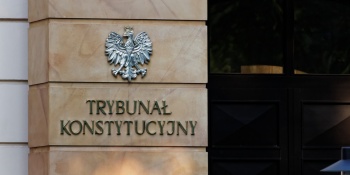
• The Polish Constitutional Tribunal ruled on June 10 that the EU Directive establishing the European Emissions Trading System (ETS) is incompatible with the Polish Constitution, as it was adopted beyond the powers granted to the European Union by Poland.
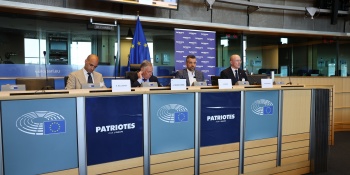
Wednesday's presentation in Brussels of the European Union reform plan developed by Poland’s Ordo Iuris Institute and Hungary’s Mathias Corvinus Collegium garnered significant interest. Nearly a hundred MEPs and their staff from many countries came to the presentation of this proposal.

• The pressure on the European Union’s southern borders has continued unabated since the great migration crisis of 2015.

• Representatives of Ordo Iuris took part in the second round of consultations ahead of the 58th Session of the UN Commission on Population and Development (CPD58) on global health policy.


© 2016 ORDO IURIS - Instytut Na Rzecz Kultury Prawnej


